0%

Choosing a Recreational Electric Golf Cart is not simply a matter of selecting the brightest color or fastest motor. The right model should fit real routines: weekend rides, gated-community travel, campground paths, or short trips across private property. Mark Wagner, former president and CEO of Club Car, once stated, “The right vehicle begins with understanding how it will be used.” That principle remains useful because appearance can distract from practical limits.

A careful buyer should examine battery type, driving range, charging time, passenger capacity, payload, ground clearance, and braking performance. Lithium-ion batteries usually reduce weight and require less maintenance, while lead-acid batteries may offer a lower purchase price. Neither option is perfect. Range also changes with hills, heavy passengers, cold weather, tire pressure, and repeated starts. A cart that travels smoothly on flat pavement may struggle on a damp, uneven trail.

Look closely at the details. Does the suspension absorb a rough campground road? Are the seats supportive after an hour? Can the charger connect safely to the available outlet? A weather-resistant roof, headlights, mirrors, seat belts, and storage space may matter more than extra speed. Local service support deserves attention too. A cheaper cart becomes frustrating when replacement parts take weeks to arrive. Test the steering, brakes, turning radius, and reverse controls before buying. Small flaws become obvious quickly.

This guide explains how to compare recreational electric golf carts with clearer expectations. It also questions popular assumptions, because the most attractive cart is not always the safest, most comfortable, or most economical choice.
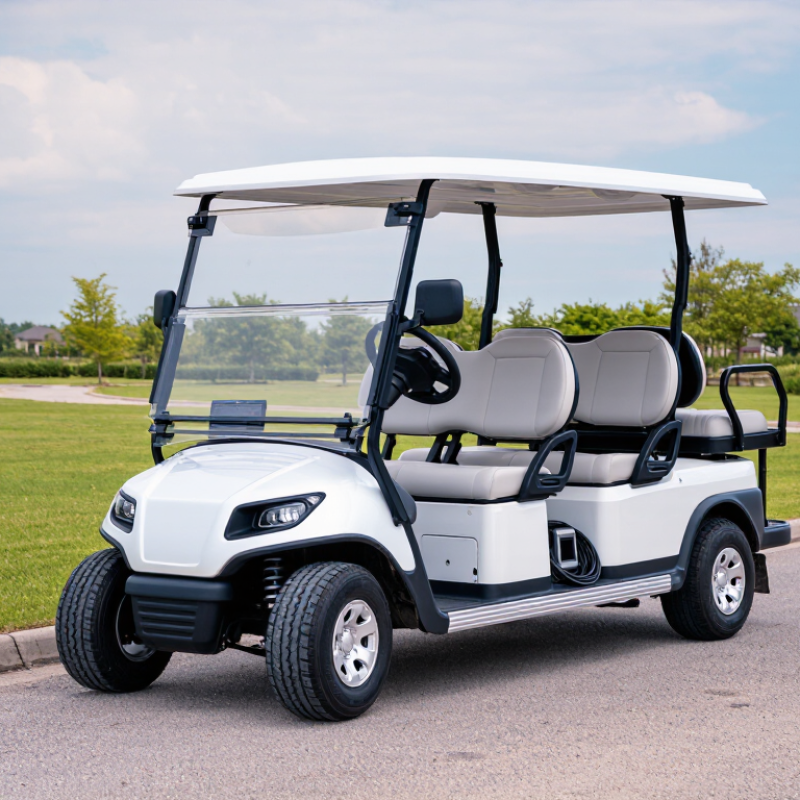
How to Choose a Recreational Electric Golf Cart?

Define Your Recreational Golf Cart Needs

Choosing a recreational electric golf cart starts with use, not color or top speed.

Write down who rides, how far, and where the cart travels. The National Golf Foundation reported about 45 million U.S. on-course golfers and 531 million rounds in 2023. Those figures show varied demand, from occasional family trips to repeated daily use.

A two-seat cart may suit a couple. A four-seat layout adds flexibility but reduces cargo space. Measure your garage width.

Terrain changes the decision.

Flat pavement needs less pulling power than wet grass, steep paths, or loose gravel. Ask for battery chemistry, usable capacity, charging time, and replacement cost in writing.

The U.S. Department of Energy’s Alternative Fuels Data Center notes that speed, temperature, terrain, and accessory loads affect electric-vehicle range. That guidance applies directionally, although a golf cart is not a road car.

Do not trust one advertised range. Test it on your actual slope, with normal passengers.

Storage needs are easy to underestimate.

Carry groceries, clubs, rain gear, or a mobility aid before choosing a rear seat. Check braking feel, steering play, lights, seat belts, ground clearance, and charger ventilation.

Local rules also matter, even inside private communities. I would choose stable handling and accessible service over impressive speed.

That choice is less glamorous. I still tend to overvalue range.

A careful trial can expose that bias.

Compare Power Systems, Range, and Charging Options

How to Choose a Recreational Electric Golf Cart?

Choosing a recreational electric golf cart starts with its power system. Lead-acid batteries usually cost less, but they are heavier and need regular water checks. Lithium-ion batteries weigh less, charge faster, and often deliver steadier performance. They also cost more initially. Your storage habits matter here. A neglected battery can reduce range quickly, regardless of its chemistry.

Range is never fixed. Passenger weight, hills, grass, tire pressure, and driving speed all change energy use. A cart traveling on flat paths may cover 25 to 40 miles per charge, while steep terrain can reduce that distance sharply. I recommend testing the cart with its typical load, not an empty vehicle. Check the battery meter after a familiar route. Numbers on a specification sheet can feel reassuring, but real conditions are less polite.

Charging options should fit your daily routine. A standard onboard charger works well near a household outlet, while a faster charger may shorten downtime. Confirm the required voltage, outlet capacity, and ventilation needs before installation. Lithium systems generally accept convenient charging schedules, but they still need compatible equipment. Charge after regular use, rather than waiting for a complete discharge. That habit is simple. It is not always followed. A weather-protected charging area also prevents moisture, cable damage, and avoidable interruptions. Local electrical requirements should be checked by a qualified professional.

How to Choose a Recreational Electric Golf Cart?

Compare power systems, estimated driving range, and charging requirements under typical recreational use with two occupants, moderate terrain, and no heavy accessories.

Key takeaway: Lead-acid systems generally cost less but require longer charging and regular maintenance. Lithium-ion systems usually provide greater usable range, shorter charging times, lower weight, and more consistent performance. A standard household outlet can charge most carts, while higher-power AC charging can reduce charging time when supported by the vehicle.

Evaluate Seating, Storage, Safety, and Ride Comfort

How to Choose a Recreational Electric Golf Cart

Seating affects comfort, balance, and everyday usefulness. Choose seats that support your lower back and allow easy entry. Rear-facing seats can carry more passengers, but they may reduce storage space. Check the cart with every seat occupied. A cart that feels stable when empty may handle differently under load.

Storage deserves a practical inspection. Look for a protected compartment, strong floor space, and room for bags, groceries, or outdoor gear. Safety equipment should include reliable brakes, working lights, mirrors, seat belts, and a visible battery indicator. Inspect the frame, tires, steering, and charging system before purchase. Small defects can become expensive maintenance problems. My first evaluation would probably focus too much on appearance. That is a mistake.

Tips: Test the cart on slopes, tight turns, and uneven pavement. Listen for rattling. Try every control. Sit for ten minutes before deciding. Adjust tire pressure only according to the manufacturer’s guidance. Ride comfort depends on suspension, seat padding, steering effort, and noise. Ask for the rated passenger and cargo capacity, then compare it with your normal use. A smooth ride is helpful, but excessive softness can reduce control. Weather protection also matters; a roof, windshield, and simple side coverage can make short trips more comfortable without making the cart difficult to handle.

Check Terrain Compatibility and Essential Features

Choosing a recreational electric golf cart starts with the ground beneath it. The U.S. Department of Energy’s Alternative Fuels Data Center notes that speed, temperature, payload, and terrain can significantly affect electric-vehicle range. A cart climbing wet grass needs more than a large battery. It needs usable torque, stable tires, strong suspension, and enough ground clearance for stones, roots, and shallow ruts. A flat-lot test can mislead.

Check the manufacturer’s tested grade rating, not only the advertised motor power. Ask whether the cart uses a limited-slip or locking differential, regenerative braking, and sealed electrical connectors. These features matter on sloped paths and loose surfaces. Choose treaded tires for woodland trails, but avoid aggressive tread if most trips involve paved roads. The wrong tire can reduce comfort and increase energy use. Small details matter.

Battery information deserves careful attention. The International Energy Agency’s Global EV Outlook 2024 reported more than 14 million electric car sales in 2023, representing about 18% of global new-car sales. That growth supports better battery technology, but recreational carts operate differently. Their range claims may assume smooth, level ground and light loads. I would request tested range conditions, charging time, battery warranty terms, and cold-weather performance. A roof, extra seats, or a heavy cooler can change the result. I would also recheck the grade rating after regular use, because confidence can age faster than the cart.

How to Choose a Recreational Electric Golf Cart? - Check Terrain Compatibility and Essential Features
Terrain or Use Condition Recommended Specifications Why It Matters Key Features to Check Before Purchase
Flat paved roads and residential paths 48-volt electrical system, two-wheel drive, standard suspension, and road-rated tires Flat surfaces require less traction and climbing power, so a standard configuration can provide efficient everyday transportation. Check the maximum legal speed, lighting, mirrors, seat belts, horn, turn signals, and whether the cart is approved for the intended road use.
Hilly neighborhoods and moderate inclines 48-volt system, high-torque motor, regenerative braking, and a rear axle designed for hill use Higher torque helps the cart start and maintain speed on slopes. Regenerative braking can assist with speed control while descending. Review the manufacturer's maximum recommended grade, hill-start performance, service-brake type, and motor controller rating. Do not rely only on top-speed figures.
Grass, gravel, and compact dirt paths All-terrain tread pattern, approximately 6-8 inches of ground clearance, and independent or upgraded front suspension Uneven and loose surfaces need improved grip, underbody clearance, and suspension travel to reduce vibration and the risk of grounding. Look for durable tires, protected wiring, a reinforced underbody, shock absorbers, and a turning radius suitable for narrow recreational trails.
Wet grass and muddy sections Deep-tread tires, sealed electrical connectors, corrosion-resistant hardware, and optional four-wheel drive for frequent use Moisture reduces traction and can accelerate corrosion. Four-wheel drive may improve control when all wheels need to contribute to forward movement. Confirm the water-resistance guidance, battery-compartment protection, drainage design, tire sidewall strength, and cleaning instructions. Avoid deep water unless specifically permitted.
Steep, loose, or rocky terrain Four-wheel drive, high ground clearance, low-speed torque control, heavy-duty suspension, and all-terrain tires Steep and unstable terrain places greater demands on traction, stability, braking, and frame strength than ordinary golf-course surfaces. Check the recommended slope limit, approach and departure angles, chassis protection, hill-hold behavior, parking brake, and occupant restraint system.
Long recreational trips Battery capacity of about 5-8 kWh, efficient 48-volt architecture, and a practical range reserve of at least 20% Actual range varies with passenger load, terrain, temperature, tire pressure, speed, and stop-and-go driving. A reserve helps prevent deep discharge during trips. Compare tested range under realistic conditions, charging time, charger output, battery warranty terms, battery weight, and the availability of a battery state-of-charge display.
Frequent passenger transport Four- or six-seat layout, a load-rated frame, reliable hydraulic or mechanical braking, and three-point or lap-and-shoulder restraints where required Additional passengers increase total weight, stopping distance, energy consumption, and the stress placed on the suspension and tires. Check the total payload rating, passenger capacity, seat-belt arrangement, handholds, step-in height, rear-seat foot protection, and cargo capacity.
Carrying equipment or outdoor supplies Payload capacity of at least 350-500 lb, a reinforced cargo bed or rear platform, and a low center of gravity Carrying capacity must include passengers, tools, supplies, and accessories. Overloading can reduce braking and steering performance. Verify the rated payload rather than cargo-bed size alone. Check tie-down points, bed dimensions, tailgate strength, suspension capacity, and the effect of cargo on range.
Hot, cold, or changing weather Battery thermal protection, weather-resistant controls, corrosion protection, and a covered charging area Temperature affects battery performance, charging behavior, tire pressure, and available range. Moisture and salt can damage electrical and metal components. Read the permitted charging-temperature range, storage requirements, battery ventilation guidance, connector protection, and cleaning or winterization procedures.
Low-maintenance recreational use Maintenance-free battery option, onboard charger, sealed bearings where applicable, and easily accessible service points Simple charging and fewer routine service tasks reduce ownership effort, especially for seasonal or occasional use. Ask about battery replacement intervals, brake adjustment, tire replacement, software or controller diagnostics, spare-parts access, and service documentation.
Quiet operation in parks or residential areas Brushless AC motor, smooth electronic speed control, low-noise tires, and controlled acceleration Electric carts are generally quieter than combustion-powered vehicles, but tire noise, drivetrain noise, and abrupt acceleration can still affect comfort. Test the cart at low and moderate speeds. Listen for gear whine, suspension noise, brake noise, and motor vibration before purchase.
Mixed terrain and year-round recreational use 48-volt system, four-wheel drive, adjustable suspension, all-terrain tires, strong lighting, and weather protection A versatile configuration balances traction, comfort, visibility, and durability across paved paths, grass, gravel, and moderate slopes. Prioritize the legally required safety equipment, realistic range, grade capability, payload rating, braking performance, charging convenience, and total operating cost.
Selection note: Specifications such as range, grade capability, payload, and charging time vary by vehicle configuration and operating conditions. Always compare the rated figures with your expected terrain, passenger load, climate, and local safety regulations.

Review Legal Requirements, Maintenance, and Total Cost

Choosing a recreational electric golf cart starts with its legal category. In the United States, a basic golf cart is not automatically a road vehicle. A low-speed vehicle must generally travel between 20 and 25 mph and meet Federal Motor Vehicle Safety Standard 500, according to the National Highway Traffic Safety Administration. Local rules may also require registration, insurance, lights, mirrors, seat belts, and a driver’s license. Check your city and state requirements before buying. Rules differ sharply.

Maintenance affects ownership more than many buyers expect. Electric drivetrains use fewer moving parts, and the U.S. Department of Energy reports that electric vehicles typically need less routine maintenance than gasoline vehicles. However, batteries still demand discipline. Lead-acid packs need water checks, clean terminals, and proper charging. Lithium batteries need compatible chargers and safe storage temperatures. A neglected cart can become expensive quickly. I once underestimated tire wear on short trips.

Calculate total cost over five years. Include the cart, charger, delivery, registration, insurance, tires, brakes, battery replacement, and electricity. The U.S. Energy Information Administration reported an average residential electricity price of about 16.5 cents per kilowatt-hour in 2024. Charging may be inexpensive, but battery replacement can dominate the budget. Request a written battery warranty, service schedule, and replacement quote. Add a small repair reserve. Real ownership is rarely as tidy as the brochure suggests.

FAQS

Should I choose lead-acid or lithium-ion batteries?

Lead-acid batteries usually cost less but weigh more and need regular water checks. Lithium-ion batteries charge faster and provide steadier performance. The higher initial cost may be difficult for some budgets.

How far can a recreational electric golf cart travel?

A cart may travel 25 to 40 miles on flat paths with one charge. Hills, grass, passenger weight, speed, and tire pressure reduce range. Real distance matters more than brochure numbers.

How should I test the cart’s actual range?

Carry the usual passengers and equipment on a familiar route. Include hills, grass, and normal driving speeds. Check the battery meter afterward. An empty-cart test can feel reassuring, but it may mislead.

What terrain features should I inspect before buying?

Look for usable torque, stable tires, strong suspension, and suitable ground clearance. These features help with stones, roots, wet grass, and shallow ruts. Flat ground hides weaknesses.

Which tires work best for mixed surfaces?

Treaded tires suit woodland paths and loose ground. Moderate tread may feel better on paved roads. Aggressive tread can increase energy use and reduce comfort.

What should I know about charging equipment?

Confirm the required voltage, outlet capacity, and ventilation needs before installation. Use compatible equipment for the battery system. A qualified professional should check local electrical requirements.

When should I charge the battery?

Charge after regular use instead of waiting for complete discharge. That habit is simple. It is also easy to ignore.

How can I protect the charging area and battery?

Use a weather-protected area to reduce moisture and cable damage. Store the cart thoughtfully, because neglected batteries can lose range quickly. I might underestimate storage discipline. The battery will not.

Conclusion

Choosing the right Recreational Electric Golf Cart starts with understanding how and where you plan to use it. Consider the number of passengers, typical travel distance, storage needs, and whether the cart will be used for casual rides, neighborhood transportation, or outdoor recreation. Compare available power systems, battery types, expected range, charging time, and charging convenience to find an option that fits your daily routine. Seating capacity, storage space, seat belts, lighting, braking performance, and overall ride comfort are also important factors.

Terrain compatibility should match your intended environment, including paved paths, grass, slopes, or uneven ground. Useful features such as adjustable suspension, durable tires, weather protection, and practical controls can improve the experience. Before purchasing, review local operating requirements, maintenance schedules, battery care, warranty coverage, and the total cost of ownership. A thoughtful comparison of performance, comfort, safety, upkeep, and long-term expenses will help you select a dependable cart that suits both your recreational needs and budget.


Evelyn

Evelyn

Evelyn is a highly skilled marketing professional with a strong understanding of the company’s products, services, and customer-focused solutions. Through years of experience in market research, content strategy, and professional communication, Evelyn translates complex product features into clear,......